Student of UK Department: Wang Yue/Bella

Full Scholarship Recipient
IGCSE Subjects & Grades: Mathematics: A*、ESL (English as a Second Language): A*、Chemistry: A*、Biology: A*、Chinese: A*、Physics: A*
Position: President of the Chemistry Club
I almost held my breath when I first saw videos of experiments like the "Crystal Rain," "Silver Mirror," luminal glow, and brilliant flame tests on screen. Those crystal-like needle-shaped crystals growing from blue droplets shimmered, as if the bottle contained a sea of stars—so beautiful it didn’t seem like science, but more like a dream.
At that moment, something in my heart was ignited—the purest curiosity and longing for the chemical world.
I started searching for chemistry experiment-related content online, bought various chemical instruments, materials, and reagents, and set up my own "micro-laboratory" in the corner of my balcony at home. Countless evenings after school, I immersed myself in preparing and observing solutions, watching those colourful liquids undergo amazing changes in my hands; all tiredness and troubles melted away.
After entering the MIC, I noticed no chemistry experiment-related club on campus. Looking at the experimental steps in textbooks that I could only imagine, and seeing the same curiosity and expectation in my classmates’ eyes as I once had, I had an idea: I would take the initiative to create a club so that more people could see the beauty of chemistry with their own eyes.
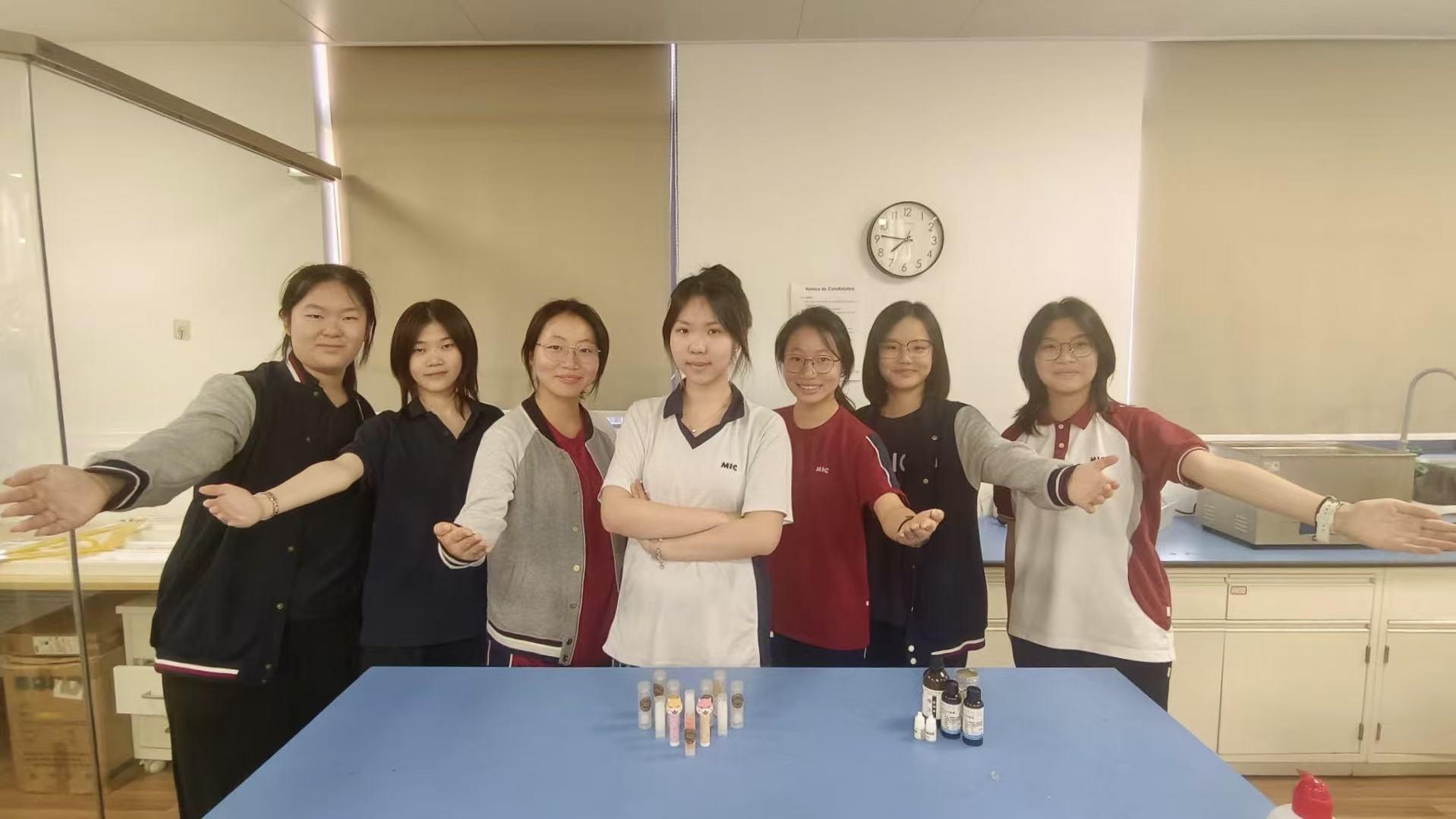
Thus, I temporarily founded the club before last semester’s recruitment. Although we were initially an unnoticeable academic club with few participants in activities, later, I connected with classmates who also shared this passion for chemistry. Classmates Anna, Fiona, and I collaborated with me to design activities, while Justin and Marcus actively took charge of putting up posters and monitoring relevant school announcements. I also spent weekends experimenting and producing batches of "blue crystal rain," "pink crystal rain," and translucent copper sulphate crystals. I also brought instruments like a plasma ball to school, hoping to make our club stand out during the second recruitment. This is how our chemistry club's “core team” emerged. We created recruitment posters with photos of our experiments, and new members soon joined through this promotion. We never wasted excess experimental products; instead, we gave them to teachers and classmates to spread the beauty of chemistry.
I remember most vividly that this semester, we finally replicated the "Three-Colour Crystal Rain" experiment I had long dreamed of—blue, pink, and yellow. A week before the experiment, we communicated with our instructor, Lisa, and purchased the relevant materials in advance. Our "core team" recorded and familiarised ourselves with the experimental procedures—members grouped by colour preference. We weighed, dissolved, heated, and mixed the substances, with three groups working simultaneously. Tiny crystals formed continuously, growing and sinking like magic—increasingly denser and denser. When the crystals fully formed, we added them to sample bottles, poured in water proportionally, and shook gently to reveal the stunning, deep-hued crystal rain. The warmth of a group of peers striving toward the same goal in the lab was unforgettable.
Someone asked me why I like chemistry so much. I think it’s because it has revealed another side of the world—behind those seemingly ordinary substances lie exquisite structures and laws; the amazing reactions in the laboratory are the most touching language of the microscopic world. I like chemistry because these experiments have taught me that chemistry is not just tedious formulas and theorems. It is a bridge connecting theory and reality, a tool for exploring the unknown, and even a form of aesthetic expression.
In the future, I hope to take this love, enter my ideal university to study chemistry-related majors, continue to explore the frontiers of this field with curiosity and expectation, use chemical knowledge to bring small changes to the world, and show more people that science can be truly romantic.
Author : 王月Bella